Posts

Don't Fail Greta

Image
Don't Fail Greta  Greta speaking at the UN climate action summit. Source:  Yahoo Greta's speech to the UN has put a lot of public attention on the climate change crisis. It's trending on social media. Climate change deniers everywhere are making childish insults addressed at this wonderful young woman or they are otherwise deflecting. Let's not fail her. One common response I have heard over the years, one way of deflecting the issue is that a person can't affect it. That idea is wrong. We can affect it. The most straightforward way of affecting this - and one that many of the same people didn't do - is that we live in a democracy. Vote for policies that will reduce the emission of greenhouse gases. Over the past period, I've taken a look at how to reduce my own footprint. I would like to share the information with you. What can you do? But beyond voting, what can you do? How can you reduce your own impact? Can we reduce our own imp...
A reply to "Open letter ...to the WHO on the issue of vaccine safety"

Image
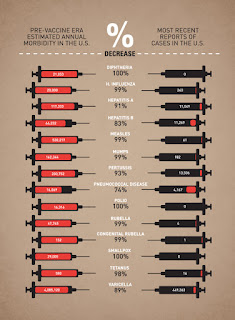
A reply to "Open letter ...to the WHO on the issue of vaccine safety" Infographic source:  Leon Farrant In a Dutch Facebook group titled "To Vaccinate: Yes or No?" (literal translation), someone posted this "Open letter to the WHO on the issue of vaccine safety", asking us what questions we think should have priority. A number of members were quick to comment that it's unclear what questions she means, calling it a bit of a word salad. I'd like to take you through the open letter, posted by the European Forum for Vaccine Vigilance (EFVV)  here . I'll try to provide both scientific papers  and human-readable  articles  as sources and mark them as such. My response to the letter By sharing science and joining efforts towards better health, your organisation has improved the lives of millions of people, and we are grateful for this. Providing better nutrition, clean water, improved hygiene, and access to medical care, mortality an...

How are your devices kept cool?

Image
How are your devices kept cool? Linus Sebastian of Linus Tech Tips  hugging a custom built computer featuring a water cooling system. In our pockets, we carry around devices that used to take the space of an entire room.  They stay cool, or sufficiently cool to operate, even though we are processing massive amounts of data at our fingertips. But how? How are computers, laptops, tablets and phones kept cool? I found myself discussing this with a friend and decided it would make for an interesting blog post. Over the last year, I've developed PC building as a hobby and cooling is one of the more interesting topics. Cooling a computer touches on a lot of topics in physics, particularly fluid flow and thermodynamics. I'll discuss the cooling of computers first, then move through laptops, tablets and phones. Rather than explain the principles first, I'd like to discuss them in passing. Computer cooling: Heat sinks and Fans AMD delivers these  Wraith ...

Let's talk about GMOs, part three: What will we use them for?

Image
Introduction In my first post , I discussed what DNA is and how it relates to phenotypical (outward) change through the central dogma of molecular biology. In the second post I discussed the techniques of genetic engineering, including the novel and prodigal technique called Crispr/Cas9. In the third and previous post we discussed current uses of the technology. In this post, we will look at the future uses of the technology.  I can not promise to cover all possible future and research purposes, simply because it is too extensive. I will discuss three good examples, one for research, one for medicine and one for food. We will leave the issue of designer babies for the next part in the series. Wide-field Fluorescence microscopy Frames from two-colour video microscopy showing single-molecules diffusing and binding  inside E-coli. [Royal Society Publishing] Wide-field fluorescence microscopy is a research technique to investigate how things work on a micros...

A new logical fallacy

Image
Fallacy: Hoc posset esse praemium. Ergo hoc est iam solvit. Introduction For the last seven years, I've been participating in online discussions of various science related subjects. It all started when, towards my second year of university, I decided to answer some physics questions on science-related facebook pages (e.g. I Fucking Love Science). Shortly into that endeavor, I started to encounter dishonest people. People that framed a question, but then aggressively started to attack your simplified explanation because they didn't agree with some part of science. This happened for all sorts of topics, such as evolution, climate change, Einstein's gravity (general relativity), genetic engineering, the list goes on. John Oliver tackled vaccines in his  show. This shot was shared in anti- vaccine groups - adding a little flavour of their own. I've seen a lot of online discussion. When I started, I had one foot firmly planted in the 'all natural' ...